1. Start with the destination rules
US EPA Tier 4 and EU Stage V have different certification, marking and documentation frameworks. The EPA states that import requirements apply to nonroad engines and equipment whether new or used, and Form 3520-21 is used for many nonroad imports, including engines installed in equipment. EU Regulation 2016/1628 governs emission limits and type approval for NRMM engines. Applicability can depend on dates, category, power and exemptions.
Prepare a one-page destination brief before requesting quotations. State the importing country, state or province where relevant, intended industry, engine power, expected entry date and whether the unit will operate on private land, in a mine or on a public road. Give that same brief to the responsible broker or authority so the answer addresses the actual transaction.
- Identify country, engine category and intended use
- Ask a broker or authority before contracting shipment
- Do not treat one market's label as proof for another
2. Record machine and engine identity separately
Request clear images of the machine plate, machine serial, engine manufacturer plate, engine model and serial, build date, engine family or type-approval number, emission label and aftertreatment labels. Begin with a contextual image showing the plate mounted on the unit, followed by readable close-ups. A typed transcription helps avoid mistakes but must not replace photographs.
Preserve original-resolution files and photograph surrounding components so the plate can be located later. Record the inspection date and the person who took the images. Where paint, corrosion or access prevents reading, do not digitally reconstruct characters; obtain service records or assistance from the engine manufacturer and keep the status unresolved until corroborated.
- Machine and engine may have different dates
- Treat missing or repainted labels as unresolved
- Keep original files and date of inspection
3. Match the label to official certification
For a US claim, use the engine-family information on the label to locate the relevant EPA certification record and compare manufacturer, family, model year, fuel, power category and certificate details. For an EU claim, obtain the applicable type-approval or conformity information and statutory marking. A machine CE mark or a generic engine brochure does not establish the identity of a repowered engine.
Keep a comparison sheet with one row for each identifier and a source column showing whether it came from the plate, controller, certificate, invoice or authority search. A single mismatch may be a transcription error, but it may also reveal a replacement engine or an unrelated certificate. Resolve the cause rather than silently correcting the record.
- Match every identifier, not only the marketing stage
- Reject a certificate for a different engine family
- Resolve inconsistencies before deposit or loading
4. Inspect emissions hardware and diagnostics
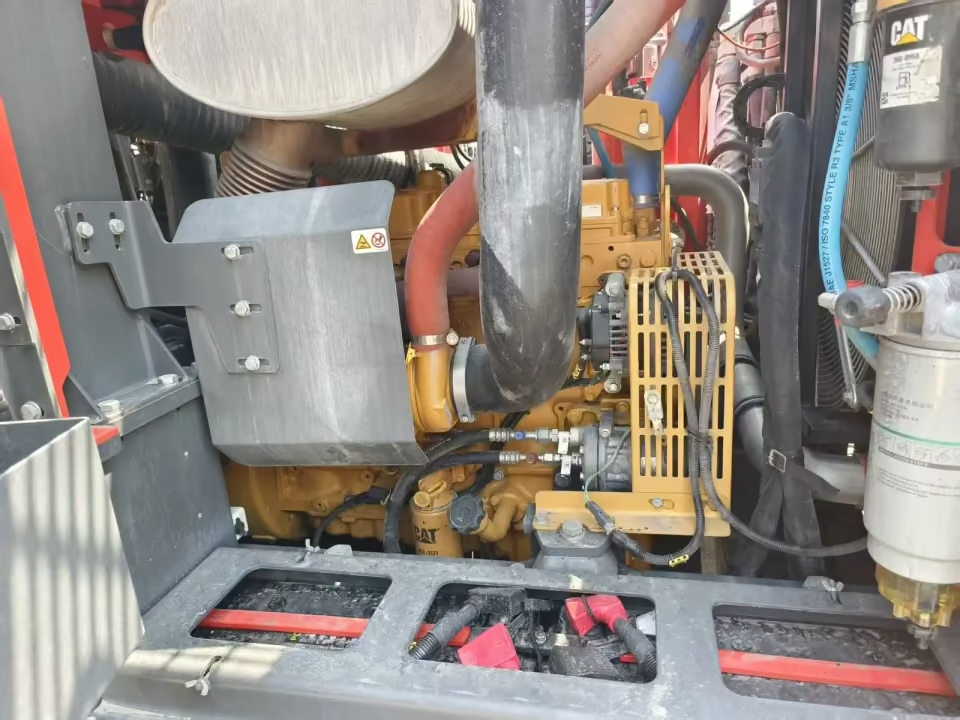
Depending on configuration, inspect the diesel oxidation catalyst, particulate filter, selective catalytic reduction and DEF or AdBlue system, plus pressure, temperature and NOx sensors. Review current and stored codes. Look for removed or hollow components, disconnected sensors, emulator devices, altered software, welded exhaust, crystallisation, leaks, soot or unexplained smoke. A running engine is not proof of lawful compliance.
Use a diagnostic tool and software appropriate for the installed engine, and save the unedited report. Check readiness, derate history and aftertreatment values only with a qualified technician who understands the system. Clearing codes before inspection destroys useful evidence; if codes were recently cleared, record that limitation and repeat checks after an agreed operating cycle.
- Photograph the complete exhaust path
- Scan faults and readiness information
- Disclose suspected deletion or tampering
5. Investigate every engine replacement
If the rig was repowered, obtain old and new serial numbers, replacement date and reason, supplier and installer, invoice, certificate and label, controller changes, cooling and exhaust modifications and current diagnostic compatibility. Do not describe the machine build year as the current engine model year unless the records prove they are the same.
- Trace the old and installed engine
- Confirm installation and control compatibility
- Reassess destination eligibility after repower
6. Build compliance into the transaction
The written agreement should state the destination, intended application, declared engine identity, supplied certificates, unaltered label photographs, repower and modification disclosures, inspection rights and responsibility if the identity is materially wrong. Make loading or final payment conditional on review by the responsible importer, broker or specialist where appropriate. Keep the verification file after delivery.
Avoid vague clauses such as emissions compliant without naming the engine and destination. Attach the identification photographs and document list to the agreement. Allocate who prepares declarations, who answers customs questions, who bears storage or return cost after a documentation failure and what remedy applies if the installed engine differs materially from the declaration.
- Allocate documentation duties clearly
- Retain declarations and supporting evidence
- Separate regulatory acceptance from mechanical condition
7. Legal and equipment limitations
This guide is educational and is not legal, customs or certification advice. Regulations, exceptions and enforcement depend on destination and facts. Nothing here proves the emission stage, import eligibility or configuration of a machine listed on this website. The importer must verify the installed engine and obtain a decision from the competent authority or qualified professional before purchase or shipment.
- No listing text replaces an authority decision
- No label alone proves mechanical health
- Verify both compliance and condition
Topic decision table: Tier 4 and Stage V: How to Verify a Used Drill Rig Before Export
| Topic checkpoint | Buyer action | Evidence-based explanation |
|---|---|---|
| 1. Start with the destination rules | Identify country, engine category and intended use | US EPA Tier 4 and EU Stage V have different certification, marking and documentation frameworks. The EPA states that import requirements apply to nonroad engines and equipment whether new or used, and Form 3520-21 is used for many nonroad imports, including engines installed in equipment. EU Regulation 2016/1628 governs emission limits and type approval for NRMM engines. Applicability can depend on dates, category, power and exemptions. |
| 2. Record machine and engine identity separately | Machine and engine may have different dates | Request clear images of the machine plate, machine serial, engine manufacturer plate, engine model and serial, build date, engine family or type-approval number, emission label and aftertreatment labels. Begin with a contextual image showing the plate mounted on the unit, followed by readable close-ups. A typed transcription helps avoid mistakes but must not replace photographs. |
| 3. Match the label to official certification | Match every identifier, not only the marketing stage | For a US claim, use the engine-family information on the label to locate the relevant EPA certification record and compare manufacturer, family, model year, fuel, power category and certificate details. For an EU claim, obtain the applicable type-approval or conformity information and statutory marking. A machine CE mark or a generic engine brochure does not establish the identity of a repowered engine. |
| 4. Inspect emissions hardware and diagnostics | Photograph the complete exhaust path | Depending on configuration, inspect the diesel oxidation catalyst, particulate filter, selective catalytic reduction and DEF or AdBlue system, plus pressure, temperature and NOx sensors. Review current and stored codes. Look for removed or hollow components, disconnected sensors, emulator devices, altered software, welded exhaust, crystallisation, leaks, soot or unexplained smoke. A running engine is not proof of lawful compliance. |
| 5. Investigate every engine replacement | Trace the old and installed engine | If the rig was repowered, obtain old and new serial numbers, replacement date and reason, supplier and installer, invoice, certificate and label, controller changes, cooling and exhaust modifications and current diagnostic compatibility. Do not describe the machine build year as the current engine model year unless the records prove they are the same. |
Apply this guide to current inventory
- Used Inventory →
- Inspection →
- Export planning for Indonesia, the Middle East and Africa →
- Drilling Rigs →
- Air Compressors →
- Sandvik DX700 · used-rig records →
- Sandvik DX800 · used-rig records →
- Sandvik DP1100 — CR-005 · used-rig records →
- Atlas Copco D45 · used-rig records →
- Atlas Copco D50 · used-rig records →
- Atlas Copco D55 · used-rig records →
- Atlas Copco T35 · used-rig records →
- Atlas Copco T40 · used-rig records →
- Used Drilling Rig Inspection Checklist: 12 Evidence-Based Checks Before You Buy →
- How to Size a Portable Air Compressor for DTH Drilling: Pressure, Flow and Site Conditions →
- How to Calculate the Real Cost per Drilled Metre →
Editorial details and evidence notes
How should the evidence be interpreted?
| Evidence type | What it can support | What it cannot prove |
|---|---|---|
| Official or manufacturer source | The cited family, standard or regulatory statement | The configuration or condition of a listed used unit |
| Published inventory record | Stock ID, supplied fields and linked listing photos | Current availability, hidden condition or included scope |
| Unit inspection evidence | Serial-specific observations within the agreed test scope | Performance outside the tested conditions |
Questions about using this guide
Does this guide prove that a listed machine has the feature or compliance discussed?
No. The guide explains a verification method. Confirm the exact stock ID, serial identity, installed configuration and destination rules before relying on it.
What should a buyer do before requesting a final quote?
Send the stock ID, project requirement, destination and requested inspection scope, then ask for current machine-specific evidence.